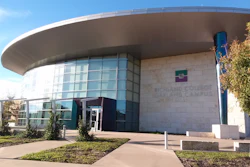
Wake Technical Community College.
Wake Technical Community College has put 21 agentic artificial intelligence assistants to work in its student services division. The college's enrollment chief says the tools have let North Carolina's largest community college handle rapid growth without cutting any jobs.
Brian Gann, Wake Tech's vice president for enrollment and student services, told participants in an Achieving the Dream webinar on Tuesday that slightly more than 1% of conversations handled by the assistants are transferred to a staff member. The rest are resolved without human involvement.
Gann appeared with Joshua Schwartz of Element451, a Raleigh, N.C.-based company that sells AI-driven customer relationship management software and automated agents to colleges and universities. Wake Tech built its assistants on the firm's platform.
“This technology is not replacing any positions,” Gann said. “It doesn't mean that positions may not shift and change.”
Community colleges nationwide are trying to decide how much of their operations and teaching to hand over to AI. Nearly all U.S. students have used the technology for academic work, according to figures presented during the webinar. But most faculty and staff say their campuses have not explained how it may be used.
Wake Tech served 76,210 unduplicated learners last academic year, from dually enrolled high school students to professionals seeking post-licensure training in public safety and health care. Degree-seeking enrollment has grown 30% in three years, and the college processed 70,000 admission applications last year. Gann said hiring has not kept up.
“I'm not in a position that I can hire my way to the scale of the human resources that it would take to serve our population,” he said.
Fourteen of the assistants support the college’s care-team advising model. There is one for each of 13 career-field meta-majors and one for veterans and military-connected students. The remaining seven work in major departments. Admissions uses three, one each for undergraduates, dual-enrollment students and international applicants, because each group has its own requirements.
Some of the assistants contact students on their own. North Carolina determines in-state residency for tuition through a centralized third-party service. When an applicant’s file is missing that determination, an admissions agent notifies the student by text, email or both. A similar process handles missing transcripts. Gann said no employee is involved in either beyond occasional manual checks.
Other work remains with people.
“We are not handing empathy to an agent. We are not handing a judgment call to an agent,” Gann said. Employees handle exceptions and any early alert involving health, wellness or finances. Reviewers also read agent conversations so they can update knowledge bases or step in when needed.
The assistants appear on Wake Tech’s care-team organizational charts alongside directors, advisers and coaches. Gann said the listing shows students that the messages come from the college and are not spam or a scam.
Gann said he wants an agent that can tell students the status of their financial aid packages. The college has tested connections that would allow it, but he is waiting for stronger data security and privacy protections.
“Honestly, I don't feel ready yet,” he said. He estimated the capability is about 12 months away.
Susan Adams, associate director for teaching and learning at Achieving the Dream, discussed a roadmap from the organization’s AI for All task force that lays out eight action areas for colleges. Its central argument is that institutions must become “AI agile” if they expect their students to be.
Adams cited national survey data showing just over half of faculty have not changed how they assess students. About a quarter have gone back to blue books and proctored exams, and another quarter have redesigned assignments around AI. She said people often misread that split as a sign that faculty are behind.
“That's not a skills gap,” Adams said. Faculty returning to handwritten exams have noticed that the essay no longer shows what students can do, she said. She called that a problem with the assignment, not with students.
Adams urged colleges to decide which tasks should stay with people. In a nursing course, she said, students should judge which symptom matters most, while AI could format the care plan. In student services, a staff member who knows a student should reach out when that student hasn’t registered for the next term. An AI tool can tell her at midnight which documents she needs.
Schwartz said 93% of U.S. students have used AI for academic work and 61% of high school students use it at least once a month. He said 80% of faculty and staff report confusion about how their institutions allow the technology to be used. He listed budgets, technical infrastructure, data privacy and a lack of strategic alignment as common barriers and said resistance among employees has eased since 2025.
“Think of the agent as being something there to support your team, not to replace your team,” Schwartz said.
Before Wake Tech adopts a new tool, its centralized AI council asks six questions, Gann said. The questions cover what problem the tool solves, what data it involves, what happens if it makes a mistake, where human judgment stays, how quality and risk will be measured, and what support employees will need.
He advised other colleges to start with small pilots. He also told them to treat each new agent “like it is a brand new junior hire,” one that will often answer, “I don't know” and needs testing until it breaks.
“We started with one agent in one department that got a lot of things wrong,” Gann said. “And we got better as we went.”
Chera Watson is a freelance journalist and a community college educator.